Agentic Recruiting and the Question of Who Moves the Pipeline
The difference between AI recruiting copilots and agents, why an agent that screens by voice gets further than one that uses forms, and which hiring metric changes first.
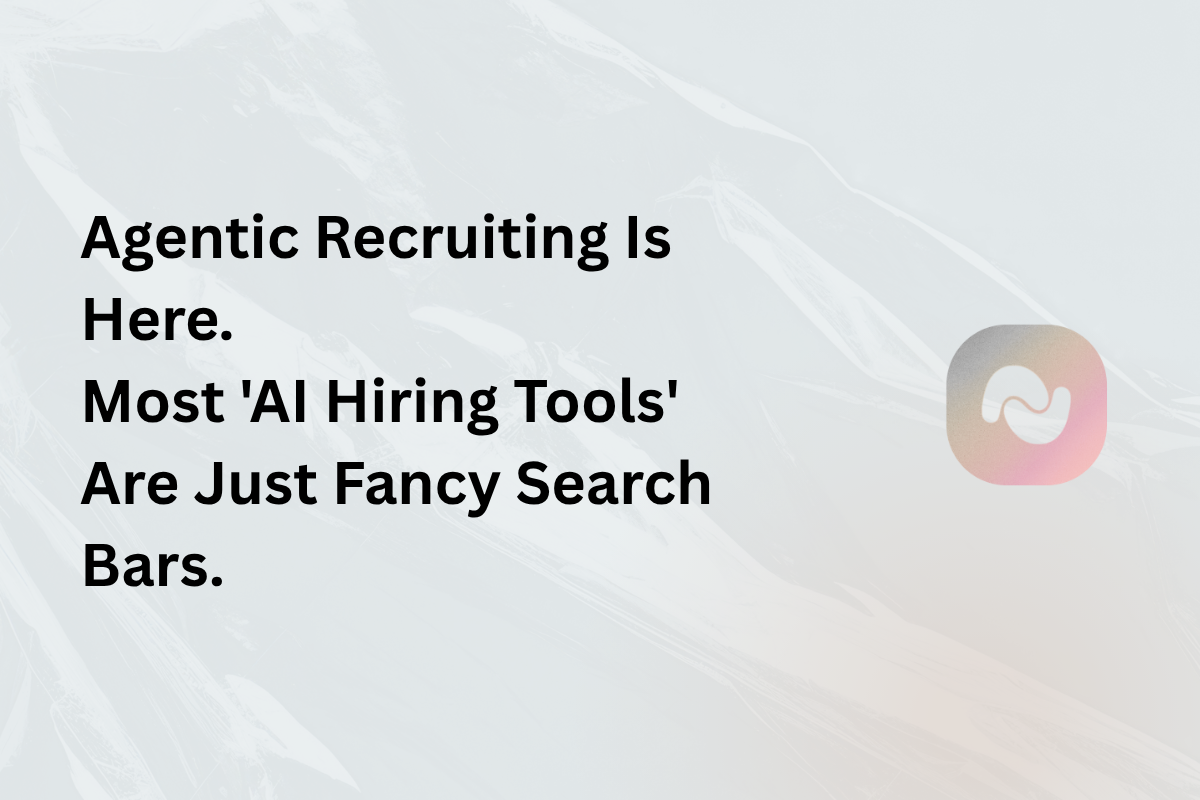
Add up the AI features in a typical recruiting stack and there are a lot of them. The software ranks resumes when you upload them. It drafts outreach when you paste in a job description. It summarizes yesterday's applicants when you open the dashboard. And yet a team with all of that can end up hiring at about the same speed it did before. Why?
I think the answer is in the words "when you." Each of those features waits for a person to do something first. The software is a copilot. It makes each step quicker, but a human still has to decide to take the step, and then the one after it. So the recruiter is still what moves the pipeline, and when the recruiter is busy it stops.
An agent works the other way around. You give it a goal, say screen these 200 applicants and find the 25 worth a human interview, and it goes and does it. It contacts candidates without being told to. It follows up with the ones who go quiet. If the pool comes up short, it moves on to the next-best group and tells you why it picked them. At the end you get a ranked shortlist with the conversations behind it, not a pile of profiles to evaluate again.
The distinction matters because of where recruiting teams actually get stuck, which usually isn't judgment. People are good at the parts of hiring that need judgment: reading nuance, sensing whether someone will fit, making the call on a close candidate. What they're bad at, through no fault of their own, is working through 300 applications, chasing people who don't reply, and writing the fourteenth version of a "just checking in" email. That is a throughput problem, and throughput is what an agent adds. A copilot makes the recruiter a little faster at that work. An agent takes it off their plate.
Why the agent should talk
If an agent does the screening, what medium should it use? The obvious answer is text: a form or a chat window. I suspect text has a lower ceiling than most people assume. A form can collect structured facts, but it can't tell someone who wants this job from someone who filled it in as one of forty open browser tabs. And written answers are easy to polish, easy to rehearse, and more and more often written by AI.
A conversation is harder to fake. Even ten minutes on the phone with an AI recruiter brings out things a form never will: a pause before the answer about travel requirements, the change in someone's voice when they describe a problem they really solved, the way they talk about their last manager when they aren't thinking about how it sounds. I don't think of that as softer information than what a form gives you. Often it predicts more.
It's also hard to game. Someone can spend an hour perfecting a written application, but they can't rehearse a live conversation the same way. So if I were designing an agentic recruiting system from scratch, I'd put voice at the front as the main screening step, rather than saving it for the final round.
That is more or less how we built Asendia. Picture it from the applicant's side. They apply, or reply to a sourcing campaign, and a short while later their phone rings. The agent on the line walks them through a structured set of qualification questions, but it listens to the answers and follows up on them, so it feels like talking to a recruiter rather than filling in a form out loud. It happens while the job is still on their mind, not days later when someone finally opens the queue. When a recruiter does get involved, the candidate has already had a real conversation, and the recruiter is looking at a verdict, qualified or not, with the candidate's own words quoted to back it up and a summary filed in the ATS. If you're hiring for high-volume roles, this post on AI hiring automation goes through the mechanics in more detail.
The number that moves first
Most teams judge hiring by time-to-hire, which lags: by the time you can measure it, the search is over. The number that changes first when you hand screening to an agent is the time between someone applying and a recruiter speaking with a candidate worth their time. You could call it time to first qualified conversation.
When people do the screening by hand, that gap is set by how long applications sit in a queue, which is usually days. With an agent doing the first pass it can be hours. That matters because strong candidates are usually talking to more than one employer, and the first one to have a real conversation with them has an edge. A recruiter who speaks to a good candidate on day one isn't really competing with the recruiter who calls on day seven.
There's one more reason I'd start early, though it's a guess rather than something I can prove. Running an agent well takes some learning: what to ask, where to set the bar, when to hand off to a person. Teams that start now will have worked that out by the time everyone else buys the same tool, and I don't think that knowledge comes in the box.
Nearly every recruiting team uses AI in some form now, so whether you use it isn't the interesting question. The interesting one is whether it does the work or only helps you do it. A quick way to find out is to ask what would happen to your pipeline if nobody on the team logged in for a week.
Ready to transform your hiring strategy? Schedule a Demo with our founders today!

Badis Zormati
Co-Founder, Asendia AI
Ready to transform your hiring strategy?
Schedule a Demo